
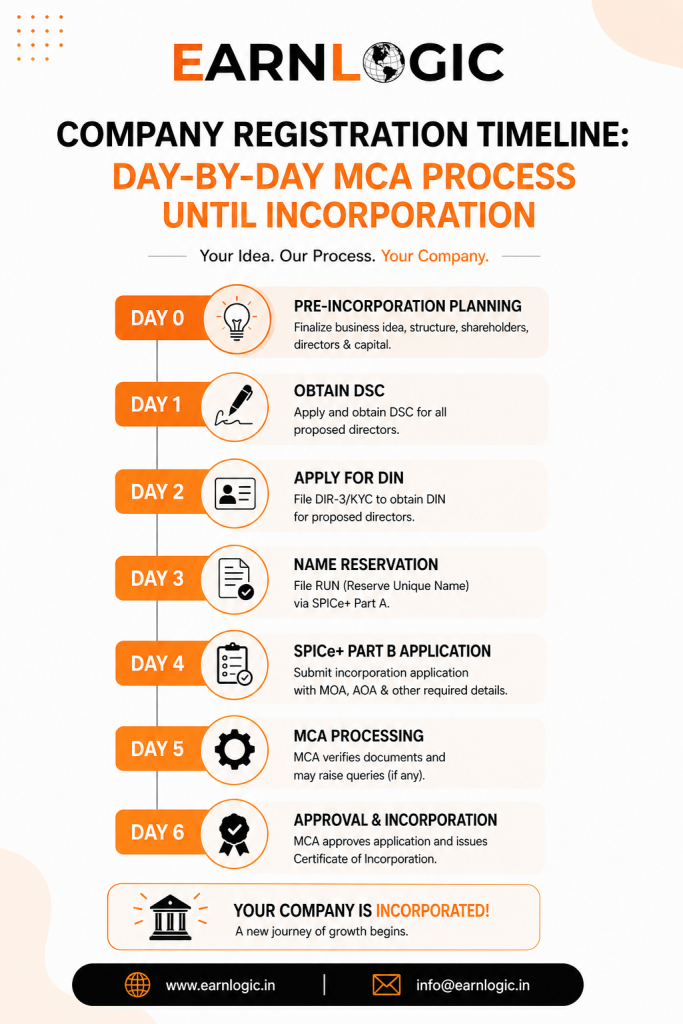
Starting a business in India involves more than simply choosing a name and beginning operations. Entrepreneurs must complete several legal and regulatory steps before a company is officially incorporated. Understanding the company registration timeline can help founders prepare documents in advance, avoid unnecessary delays, and plan their business launch more effectively.
At EarnLogic, we understand that company registration can seem complicated, especially for first-time entrepreneurs. From selecting the appropriate business structure to filing incorporation forms with the Ministry of Corporate Affairs (MCA), every stage requires careful attention to detail.
The actual registration period may vary depending on document accuracy, name availability, MCA processing, and whether any clarification or resubmission is required. Below is a practical day-by-day overview of the company incorporation process in India.
Day 1: Choose the Right Business Structure
The first step is to determine which legal structure best suits your business. The choice can affect ownership, liability, taxation, compliance requirements, and future fundraising opportunities.
Common business structures include:
- Private Limited Company
- One Person Company (OPC)
- Public Limited Company
- Limited Liability Partnership (LLP)
A Private Limited Company registration in Coimbatore is commonly preferred by businesses planning for future growth, external investment, and a structured ownership model. An OPC may be suitable for a single entrepreneur, while an LLP can be considered where flexibility in management and partnership is important.
Before proceeding with registration, evaluate your business objectives and long-term plans carefully.
Day 2: Select and Check the Company Name
Choosing a suitable company name is an important part of the incorporation process. The proposed name should be distinctive, relevant to the business activity, and compliant with applicable MCA naming requirements.
Before finalising the name, check for:
- Existing company or LLP names
- Similar or confusingly similar names
- Trademark conflicts
- Restricted or regulated words
- Relevance to the proposed business activity
It is also advisable to keep alternative names ready. If the preferred name is unavailable or rejected, having alternatives can help avoid unnecessary delays.
For entrepreneurs seeking guidance with the company registration process, EarnLogic can help simplify the preparation and documentation involved.
Day 3: Collect Director and Subscriber Documents
Commonly required information and documents include:
- PAN card
- Identity proof
- Address proof
- Passport-size photograph
- Email address
- Mobile number
- Digital Signature Certificate (DSC)
All details should be checked carefully. Names, dates of birth, addresses, and other information should be consistent with official records.
Even a small mismatch in documentation can result in clarification or resubmission during the MCA review process.
Day 4: Prepare Registered Office Documents
Every company incorporated in India must have a registered office address.
Depending on the ownership or occupancy arrangement, documents may include:
- Proof of registered office address
- Recent utility bill
- Rental or lease agreement
- Ownership document, where applicable
- No Objection Certificate (NOC), where required
The address and supporting documents should be consistent. Entrepreneurs should carefully verify the registered office documentation before submitting the incorporation application.
Day 5: Verify Digital Signature Certificates
The incorporation process is completed electronically, making Digital Signature Certificates important for the relevant directors and subscribers.
Before filing, verify that:
- The DSC is valid and active
- The DSC belongs to the correct applicant
Resolving DSC-related issues before filing can help prevent avoidable technical or procedural delays.
Day 6: Prepare SPICe+ Incorporation Details
The next stage involves preparing the information required for the incorporation application.
The SPICe+ process may require details relating to:
- Proposed company name
- Registered office
- Directors
- Subscribers
- Shareholding pattern
- Authorised and subscribed capital
- Main business activities
- Other applicable registrations
This stage deserves particular attention because errors in business activity, shareholding, capital structure, or director information may result in the application being sent back for correction.
A detailed review before submission can save considerable time later.
Day 7: Submit the Incorporation Application
After completing the necessary information and documentation, the incorporation application can be submitted electronically through the MCA system.
Depending on the company’s eligibility and requirements, the integrated incorporation process may cover applications or registrations relating to areas such as:
- Director Identification Number (DIN)
- Permanent Account Number (PAN)
- Tax Deduction and Collection Account Number (TAN)
- GST registration, where applicable
- EPFO
- ESIC
- Other applicable registrations
The exact requirements depend on the company’s circumstances and applicable rules.
Day 8–10: MCA Review and Verification
After submission, the Ministry of Corporate Affairs reviews the incorporation application and supporting documents.
The processing time can depend on several factors, including:
- Accuracy of the application
- Quality of submitted documents
- Name availability
- Registered office documentation
- Nature of business activity
- Whether clarification is required
If the information is complete and acceptable, the application can proceed towards approval.
However, entrepreneurs should remember that the timeline is an estimate rather than a guaranteed processing period.
What Happens If MCA Requests Resubmission?
One of the most common reasons for an extended opc registration in coimbatore is a resubmission or requirement for clarification.
MCA may raise concerns relating to:
- Similarity of the proposed company name
- Trademark-related issues
- Incorrect director information
- Registered office documentation
- Missing or incomplete documents
- Incorrect capital structure
- Shareholding inconsistencies
- Business activity descriptions
If resubmission is required, the applicant must address the observations and submit the corrected information within the applicable timeframe.
This is why proper document preparation is important from the beginning.
Day 10–15: Certificate of Incorporation
Once the application successfully completes the required review, the company can receive its Certificate of Incorporation.
The certificate confirms that the company has been incorporated and generally contains important details such as:
- Company name
- Corporate Identity Number (CIN)
- Date of incorporation
- Company type
- Registered office information
The actual time required can vary depending on the application, MCA processing, and whether any corrections are requested.
What Happens After Company Incorporation?
Receiving the Certificate of Incorporation is an important milestone, but it is not the end of the company’s legal and compliance responsibilities.
After incorporation, the company may need to take several additional steps, including:
- Opening a corporate bank account
- Bringing in subscribed share capital, where applicable
- Maintaining proper accounting records
- Completing applicable GST requirements
- Maintaining statutory registers
- Completing required ROC filings
- Meeting applicable Income Tax requirements
- Completing other post-incorporation compliances
The specific obligations depend on the company’s structure, activities, turnover, employees, and applicable regulations.
How to Avoid Delays in Company Registration
Entrepreneurs can reduce avoidable delays by preparing carefully before submitting their application.
Some useful precautions include:
- Prepare all required documents in advance.
- Check the proposed company name carefully.
- Review possible trademark conflicts.
- Keep alternative names available.
- Verify director and subscriber information.
- Ensure registered office documents are complete.
- Check that DSCs are valid.
- Review capital and shareholding details.
- Ensure the business activity is described appropriately.
- Review the complete application before submission.
At EarnLogic, the objective is to make the company registration journey easier to understand by providing practical guidance and professional support for entrepreneurs navigating the incorporation process.
Conclusion
The Private limited company registration in Coimbatore involves multiple stages, beginning with selecting the right business structure and company name and continuing through document preparation, registered office verification, SPICe+ filing, MCA review, and issuance of the Certificate of Incorporation.
While a straightforward application may move through the process relatively quickly, the actual timeline can vary depending on document accuracy, name approval, MCA processing, and whether resubmission is required.


