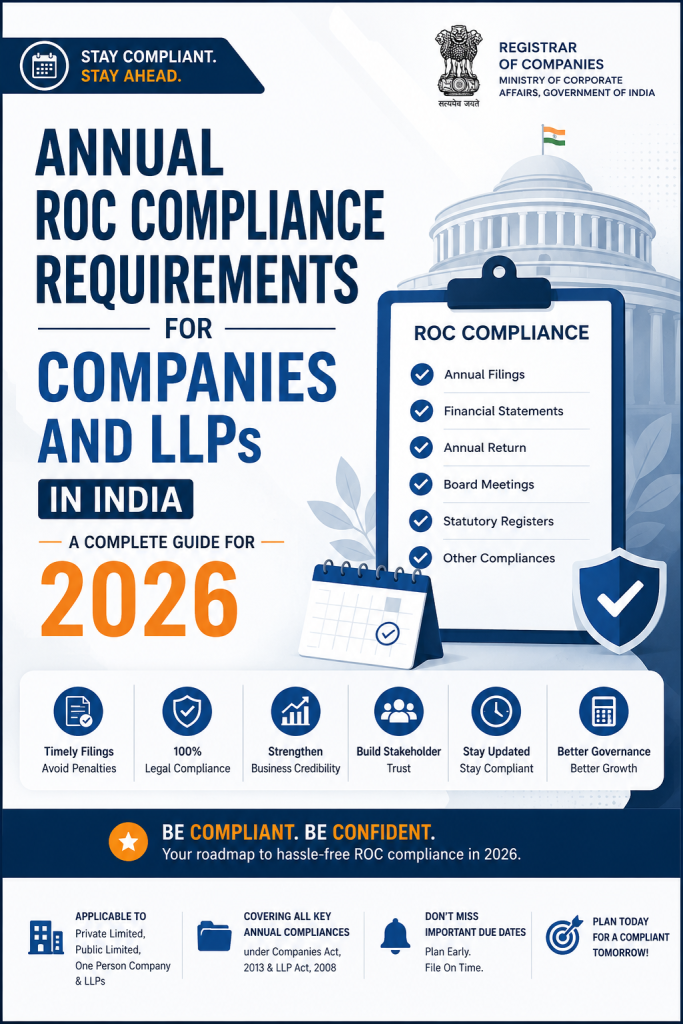
Maintaining compliance with the Registrar of Companies (ROC) is one of the most important responsibilities for businesses operating in India. Whether you run a private limited company, public company, startup, or Limited Liability Partnership (LLP), annual ROC compliance ensures that your business remains legally compliant, transparent, and trustworthy in the eyes of regulators, investors, and stakeholders.
Many businesses focus heavily on growth, fundraising, and operations but often overlook statutory compliance requirements. Missing important ROC filing deadlines can result in penalties, legal complications, director disqualification, and even the removal of the company from government records. As regulatory scrutiny continues to increase in 2026, businesses must understand their compliance obligations and ensure timely filing of all required forms.
This guide explains the annual ROC registration in Coimbatore compliance requirements for companies and LLPs, the consequences of non-compliance, and best practices for staying compliant throughout the year.
Annual ROC Compliance Requirements for Companies
Every company registered under the Companies Act, 2013 is required to fulfill several annual compliance obligations. These filings provide the Ministry of Corporate Affairs (MCA) with updated information about the company’s financial health, management structure, and operational status.
Annual General Meeting (AGM)
One of the primary annual compliance requirements is conducting the Annual General Meeting (AGM). Companies are generally required to hold their AGM within six months from the end of the financial year.
The AGM serves as an important platform where shareholders review the company’s performance, approve financial statements, discuss corporate matters, and make key decisions regarding the future of the business. Conducting the AGM within the prescribed timeline is essential because several ROC filing deadlines are linked to the date of the AGM.
Failure to hold the AGM on time may attract penalties and create compliance complications for the company and its directors.
Filing of Financial Statements – Form AOC-4
After the AGM is completed, companies must file their financial statements with the Registrar of Companies through Form AOC-4.
The financial statements generally include:
- Balance Sheet
- Profit and Loss Account
- Cash Flow Statement (where applicable)
- Auditor’s Report
- Board’s Report
- Notes to Accounts
Form AOC-4 must be filed within 30 days from the date of the AGM.
The purpose of this filing is to provide regulators with a clear understanding of the company’s financial position and performance during the financial year. Investors, lenders, and other stakeholders often rely on these records to evaluate a company’s stability and credibility.
Delayed filing of AOC-4 results in additional fees and may expose the company to regulatory action.
Filing of Annual Return – Form MGT-7
Another critical compliance requirement is the filing of the annual return through Form MGT-7.
This form contains detailed information regarding:
- Shareholding pattern
- Directors and key managerial personnel
- Registered office details
- Members and debenture holders
- Corporate governance information
- Changes in management structure
Companies are required to file Form MGT-7 within 60 days of the AGM.
The annual return provides a comprehensive overview of the company’s corporate structure and governance practices. Timely filing helps maintain transparency and ensures that official records remain up to date.
Failure to submit MGT-7 within the prescribed timeline can lead to penalties and may adversely affect the company’s compliance standing.
Auditor Appointment – Form ADT-1
Companies are also required to notify the Registrar of Companies regarding the appointment or reappointment of statutory auditors through Form ADT-1.
The form must be filed within 15 days of the AGM.
Auditors play a crucial role in verifying the accuracy and reliability of financial statements. Filing ADT-1 ensures that the MCA has updated information regarding the company’s auditors and helps maintain accountability in financial reporting.
DIR-3 KYC for Directors
Every individual holding a Director Identification Number (DIN) must complete DIR-3 KYC annually.
The objective of this filing is to verify and update the personal information of company directors maintained by the Ministry of Corporate Affairs. The filing includes details such as contact information, email address, and identification documents.
The due date for DIR-3 KYC is 30th June each year.
Failure to complete DIR-3 KYC can result in the deactivation of the DIN, preventing directors from carrying out important corporate filings and activities until compliance is restored.
Annual ROC Compliance Requirements for LLPs
Limited Liability Partnerships registration in Coimbatore have a comparatively simpler compliance structure than companies. However, LLPs are still required to fulfill mandatory annual filing obligations regardless of their turnover, revenue, or level of business activity.
Form 11 – Annual Return
Every LLP must file Form 11, commonly known as the Annual Return.
This filing includes important information such as:
- Details of designated partners
- Partner contributions
- Changes in partnership structure
- Basic LLP information
The due date for filing Form 11 is 30th May every year.
Even LLPs that have not carried out any business activities during the year are required to submit this return. Failure to do so can result in significant penalties.
Form 8 – Statement of Accounts and Solvency
Another important annual compliance requirement for LLPs is filing Form 8.
This document includes:
- Statement of assets and liabilities
- Income and expenditure details
- Declaration of solvency
- Financial position of the LLP
Form 8 must be filed on or before 30th October every year.
This filing allows regulatory authorities to assess the LLP’s financial stability and ability to meet its obligations. Timely filing is essential for maintaining compliance and avoiding additional fees.
Consequences of Missing ROC Compliance Deadlines
Many businesses underestimate the impact of missing compliance deadlines. However, non-compliance can have severe financial and legal consequences.
Additional Filing Fees
The Ministry of Corporate Affairs imposes an additional fee of ₹100 per day for delayed ROC filings. Since there is no maximum cap on this fee, prolonged delays can result in substantial financial burdens.
For startups and small businesses operating with limited resources, these penalties can become a significant expense.
Monetary Penalties
Apart from additional filing fees, companies and directors may face separate penalties for non-compliance.
Directors may be liable to pay fines ranging from ₹10,000 to ₹1,00,000 depending on the nature and severity of the default. Similarly, companies may face penalties ranging from ₹25,000 to ₹5,00,000.
Director Disqualification
One of the most serious consequences of prolonged non-compliance is director disqualification.
If a company fails to file annual returns or financial statements for three consecutive financial years, the directors may become disqualified from serving as directors in any company for up to five years.
This can significantly impact both personal and professional opportunities for business leaders.
Strike-Off of Company
In cases of continuous non-compliance or prolonged inactivity, the Trademark Registration of Companies may initiate strike-off proceedings.
When a company is struck off, its name is removed from official government records, effectively terminating its legal existence. Restoring a struck-off company can be a lengthy and costly process.
Best Practices for Maintaining ROC Compliance
Businesses can avoid compliance issues by adopting a proactive approach throughout the year.
Some practical steps include:
- Maintaining accurate financial records and bookkeeping.
- Tracking compliance deadlines through compliance calendars.
- Conducting internal reviews before filing statutory forms.
- Completing audits and financial statement preparation well in advance.
- Appointing qualified compliance professionals or consultants.
- Regularly monitoring updates issued by the Ministry of Corporate Affairs.
Conclusion
ROC compliance is not merely a legal formality—it is an essential aspect of responsible business management. Timely filing of annual returns, financial statements, auditor appointments, and director KYC helps companies and LLPs maintain good standing with regulatory authorities and build trust among investors and stakeholders.
As businesses continue to grow in a competitive environment, maintaining a strong compliance record can provide a significant advantage. By understanding annual compliance requirements and adhering to prescribed deadlines, organizations can avoid penalties, protect their reputation, and focus on achieving long-term business success.