
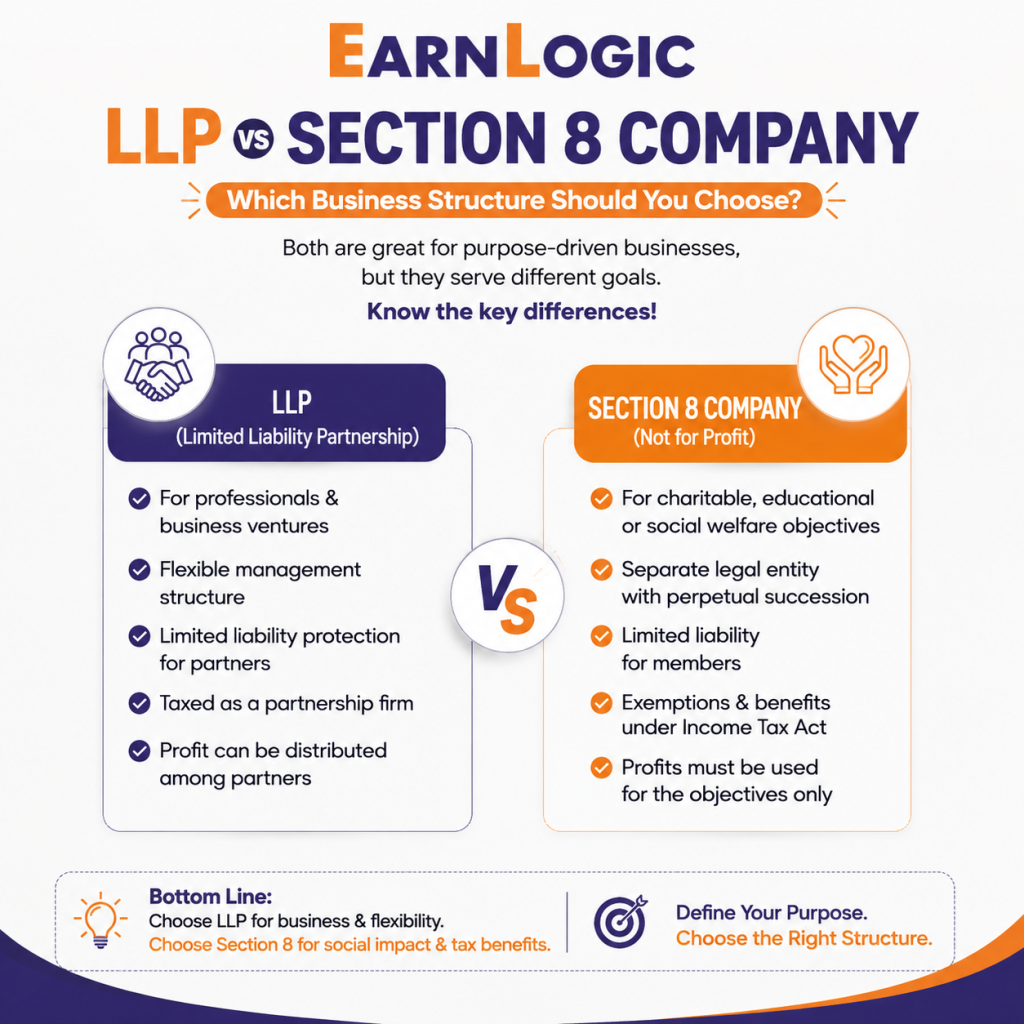
Choosing the right legal structure is an important step when starting a business, professional venture, or non-profit organisation in India. The structure you select can influence how the organisation is managed, how liability is handled, how profits are treated, and what level of statutory compliance is required.
Two structures that serve very different purposes are a Limited Liability Partnership (LLP) and a Section 8 Company. An LLP is generally suitable for entrepreneurs, professionals, and partners who intend to operate a commercial business. A Section 8 Company is designed for organisations that work towards charitable, social, educational, environmental, cultural, scientific, or other public-benefit objectives.
Understanding the key differences between an LLP and a Section 8 Company can help you choose a structure that matches your long-term goals.
What is a Limited Liability Partnership (LLP)?
A Limited Liability Partnership is a separate legal entity governed by the Limited Liability Partnership Act, 2008. It combines the operational flexibility of a traditional partnership with the benefit of limited liability.
An LLP requires at least two partners, with at least two designated partners responsible for statutory compliance. At least one designated partner must generally be a resident of India. The rights, responsibilities, capital contributions, profit-sharing arrangements, and management procedures of the partners are normally set out in an LLP Agreement.
One of the main advantages of an LLP is that it provides a separate legal identity from its partners. It can enter into contracts, own property, and conduct business in its own name. Partners can also enjoy limited liability, subject to the applicable provisions of law.
LLPs are commonly considered by professional firms, consultants, service providers, startups, and businesses established by two or more entrepreneurs. They can also be attractive where the partners want a relatively flexible management structure and do not require the conventional shareholder-based structure of a company.
What is a Section 8 Company?
A Section 8 Company is incorporated under the Companies Act, 2013 for promoting specific non-profit objectives. These may include education, science, commerce, art, sports, research, social welfare, charity, environmental protection, and other activities benefiting society.
The fundamental purpose of a Section 8 Company registration in Coimbatore is not to distribute profits among its members. Any income or surplus generated through its activities is generally expected to be applied towards achieving the organisation’s stated objectives.
A Section 8 Company therefore provides a formal corporate structure for organisations that want to pursue long-term social or public-benefit activities. It may also be suitable for organisations seeking to establish a structured and credible framework for working with donors, institutions, and other stakeholders.
Earnlogic’s Section 8 registration services highlight areas such as education, research, sports, environmental protection, social welfare, charity, and similar objectives as potential areas for a Section 8 organisation.
LLP vs Section 8 Company: Key Differences
Although both structures provide a separate legal framework, an LLP and a Section 8 Company are fundamentally different in purpose and operation.
- Difference in Purpose
The biggest distinction is the objective of the organisation.
An LLP is primarily intended for commercial activities. Partners can provide services, sell products, enter into contracts, earn revenue, and distribute profits according to the terms of the LLP Agreement.
A Section 8 Company serves non-profit objectives. It should direct its activities towards the purposes stated in its constitutional documents and generally use its income to further those objectives.
Therefore, entrepreneurs establishing a profit-making business may consider an LLP, while promoters working towards charitable or social objectives may consider a Section 8 Company.
- Ownership and Management
An LLP is operated by its partners. The LLP Agreement determines the organisation’s management, decision-making process, handling of contributions, and sharing of profits.
A Section 8 Company follows a corporate governance structure involving members and directors. Its management is subject to the Companies Act, 2013, as well as its constitutional documents.
As a result, an LLP generally provides greater contractual flexibility between partners, whereas a Section 8 Company follows a more formal corporate governance framework.
- Liability Protection
Both structures provide separate legal identity and limited liability protection, subject to applicable law.
In an LLP, partners are generally not personally liable merely because another partner has committed an act or omission. The liability framework is one of the key features that distinguishes an LLP from an ordinary partnership.
This separation between the organisation and its members or partners can help protect personal assets from business or organisational liabilities, subject to legal exceptions.
- Treatment of Profits
Profit distribution is another major difference. The LLP Agreement and applicable tax provisions determine how partners can distribute profits in an LLP. This makes the structure suitable for entrepreneurs who expect to generate commercial profits and share them among the partners.
A Section 8 Company follows a different model.The organisation generally cannot distribute its profits or surplus to members as dividends. Instead, it should use the funds to promote and achieve its approved objectives.
- Compliance Requirements
LLPs generally have a comparatively flexible compliance framework.They must maintain appropriate records and complete all applicable statutory filings.
For example, LLPs must file annual returns and financial information with the appropriate authorities. Earnlogic’s LLP compliance information identifies Form 11 and Form 8 among the important annual filings for LLPs.
Therefore, promoters should consider not only the initial registration process but also the ongoing compliance responsibilities before choosing a structure.
- Capital and Funding
An LLP can receive contributions from its partners and generate revenue through its commercial activities. The LLP structure can therefore work well for businesses where the partners themselves provide the initial capital and the business generates income through products or services.
A Section 8 Company may receive donations, grants, contributions, and other permissible funding depending on its activities and eligibility. This can make it suitable for organisations working in areas such as education, social welfare, research, environmental protection, sports, and charitable activities.
Organisations intending to receive foreign contributions should also evaluate the additional legal and regulatory requirements that may apply.
- Minimum Capital Requirements
An LLP does not require a prescribed minimum capital contribution for incorporation. The partners can determine their contribution according to their agreement and business requirements.
Similarly, a Section 8 Company does not require a prescribed minimum paid-up capital under the registration framework described by Earnlogic.
This allows promoters to establish either structure without having to meet a large mandatory capital requirement.
Which Structure Should You Choose?
The right structure depends primarily on what you intend to achieve.
An LLP may be suitable if:
- You are starting a profit-oriented business with two or more partners.
- You want to provide professional or commercial services.
- Partners want to share business profits.
- You prefer flexibility in management and decision-making.
- You want a separate legal identity with limited liability protection.
- You want a business structure with comparatively flexible compliance requirements.
A Section 8 Company may be suitable if:
- Your primary objective is charitable or social rather than profit distribution.
- You intend to work in education, research, sports, environmental protection, art, social welfare, or similar fields.
- You want a formal corporate structure for a long-term non-profit initiative.
- You expect to work with donors, institutions, or organisations supporting public-benefit activities.
LLP Registration and Section 8 Company Registration
The registration process differs for each structure.
For an LLP, the process generally involves selecting and reserving a suitable name, obtaining Digital Signature Certificates, preparing the required incorporation documents, filing the registration application, and completing the LLP Agreement after incorporation.
For a Section 8 Company, promoters need to establish that the proposed organisation has eligible non-profit objectives. The incorporation process involves documentation such as the Memorandum of Association and Articles of Association, along with the prescribed company registration requirements.
Professional assistance can make the incorporation process easier by helping with documentation, application filing, and applicable statutory procedures.
Conclusion
An LLP is generally a practical choice for entrepreneurs, professionals, consultants, and business partners who want to conduct commercial activities, retain management flexibility, and share profits while benefiting from limited liability.
Before choosing between the two, promoters should evaluate their objectives, funding model, management structure, expected revenue, profit-distribution requirements, and ongoing compliance obligations.
If you are planning a commercial venture, professional support for LLP Registration in Coimbatore can help you establish the appropriate business structure and complete the required formalities. If your goal is to create a non-profit organisation, Section 8 Company Registration in Coimbatore can provide a structured corporate framework for pursuing your social or charitable objectives.
The right choice ultimately depends on your organisation’s purpose. Choose an LLP when your focus is business and profit generation; choose a Section 8 Company when your primary goal is creating social or public benefit without distributing profits to members.